


NCERT Solutions for Class 10 Science Chapter 12 "Magnetic Effects of Electric Current"
Have you ever wondered how a toy car moves, how a doorbell rings, or how sound comes out of a loudspeaker? It is answered by the magnetic effects of electric current, a curious thing which shows how magnetism can be produced by electricity. Solenoids, electromagnets, and electric motors are some of the real-life devices where this principle is applied, and thus, it is an essential component of physics and technology.
This Story also Contains
- NCERT Solutions for Class 10 Science Chapter 12 - Magnetic Effects of Electric Current: Download PDF
- Magnetic Effects of Electric Current NCERT Solutions: In-text Questions
- NCERT Solutions for Class 10 Science Chapter 12: Additional In-text Questions
- Class 10 Science Chapter 12 - Magnetic Effects of Electric Current: Exercise Solutions
- NCERT Solutions for Class 10 Science Chapter 12: Additional Questions
- Class 10 Science Chapter 12 - Magnetic Effects of Electric Current: Higher Order Thinking Skills (HOTS)
- Magnetic Effects of Electric Current NCERT Solutions: Important Topics
- NCERT Solutions for Class 10 Science Chapter 12: Important Formulas
- NCERT Class 10 Science Solutions Chapter 12 - Weightage in Board Exams
- Approach to Solve Questions of the Magnetic Effect Of Electric Current
- Benefits of NCERT Solutions Class 10 Chapter 12: Magnetic effects of electric current
- How Can NCERT Solutions for Class 10 Science Chapter 12 Help in Exam Preparation?
- What You Will Learn from NCERT Solutions for Class 10 Science Chapter 12: Magnetic Effects of Electric Current?
- NCERT Solutions for Class 10 Science: Chapter Wise
- NCERT Solutions for Class 10: Subject Wise
- NCERT Notes for Class 10: Subject Wise
- NCERT Books and Syllabus

Magnetic Effects of Electric Current, Class 10, Science Chapter 13, is not only an important chapter in the CBSE syllabus but also tends to have a lot of weightage in the competitive exams. The chapter dwells on concepts such as the Magnetic Field, the Right-Hand Thumb Rule, and Electromagnetic Induction. Using NCERT Solutions for Class 10 Science Chapter 12 - Magnetic Effects of Electric Current, students obtain step-by-step solutions of in-text and exercise questions, as well as Higher Order Thinking Skills (HOTS) problems for higher-level practice. These NCERT Solutions for Class 10 Science Chapter 12 - Magnetic Effects of Electric Current help students not only do well in school and board exams but also prepare well to compete with exams such as NTSE, IOQJS, and NSTSE.
NCERT Solutions for Class 10 Science Chapter 12 - Magnetic Effects of Electric Current: Download PDF
The Class 10 Science Chapter 12 - Magnetic Effects of Electric Current question answers are clearly well-structured, and key concepts can be understood easily by students, as all the questions in the textbook are answered. These class 10 science chapter 12 Magnetic Effects of Electric Current question answers can be downloaded in free PDF format so that one can access them offline as well as prepare for their examination.
Download the chapter-wise formula of NCERT class 10 science by clicking on the link given in the box.
Magnetic Effects of Electric Current NCERT Solutions: In-text Questions
Magnetic Effects of Electric Current Class 10 question answers (in-text questions) contain clear step-wise explanations to various concepts/phenomena such as magnetic field, right-hand thumb rule, electromagnetic induction, etc. These class 10 science chapter 12 Magnetic Effects of Electric Current question answers can make students knowledgeable about how magnetism can be used in everyday life, and they would reinforce the exam preparations.
Topic 12.1, Page Number- 196
Q.1 Why does a compass needle get deflected when brought near a bar magnet?
Answer:
The compass needle has a magnet inside it, and when it is brought near the magnet, it gets deflected due to the magnetic force between the two magnets. The South of the needle points towards the magnetic North of the bar magnet, and the North of the needle points away from the North of the bar magnet. (Like pole attracts and unlike pole repels)
Topic 12.2, Page Number- 200
Q.1 Draw magnetic field lines around a bar magnet.
Answer:
The magnetic field lines emerge from the North pole of the bar magnet and merge into the South pole. That is, inside the bar magnet, the field lines are from South to North, and outside it is from North to South.
.png)
Q.2 List the properties of magnetic field lines
Answer:
Some properties of magnetic field lines are
1) They never intersect with each other. If they intersect, there must be two directions of the magnetic field, which is not possible
2) The direction of magnetic field lines is from the North pole to the South pole outside the magnet and from the South pole to the North pole inside the magnet.
3) The field lines emerge from the north pole and merge at the south pole.
Q.3 Why don’t two magnetic field lines intersect each other?
Answer:
Two magnetic field lines do not intersect each other because the resultant magnetic field due to both poles can be in only one direction, and if they intersect, then there will be two directions of the magnetic field, which is impossible.
Topic 12.2, Page Numbers- 201-202
Answer:
When we pass the current clockwise, the magnetic field lines will emerge from outside the loop and will merge inside the loop.
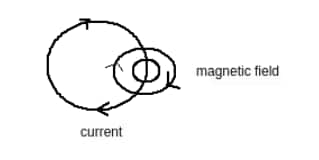
Q.2 The magnetic field in a given region is uniform. Draw a diagram to represent it.
Answer:
The Uniform Magnetic Field can be represented as:
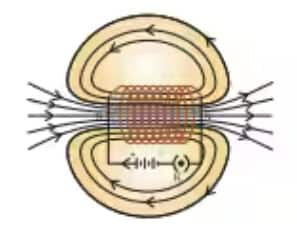
Q.3 Choose the correct option.
The magnetic field inside a long straight solenoid carrying current
(b) decreases as we move towards its end.
(c) increases as we move towards its end.
(d) is the same at all points.
Answer:
The magnetic field inside a long straight solenoid carrying current is Uniform in nature, so the magnetic field is the same at all points.
Hence, option (d) is the correct answer.
Topic 12.3, Page Number- 203
Answer:
When a proton moves in the magnetic field, it experiences a force. This force will always be in a direction perpendicular to the direction of motion, so the proton will always perform circular motion. Therefore, the velocity and momentum can change,
Hence, options (c) and (d) are the correct answers.
Answer:
When a current-carrying wire is placed in the magnetic field, it experiences a force.
This force is proportional to the length of the wire, the strength of the magnetic field and the magnitude of the current passing through the wire.
Hence, when the current in rod AB is increased, it will experience a greater force and hence will be more displaced.
Answer:
When a current-carrying wire is placed in the magnetic field, it experiences a force; this force is proportional to the length of the wire, the strength of the magnetic field and the current through the wire.
Hence, when a stronger horseshoe magnet is used, the strength of the magnetic field is high, and it will experience a greater force and hence will be more displaced.
Q. 2. c) In Activity 12.7, how do we think the displacement of rod AB will be affected if the length of the rod AB is increased?
Answer:
When a current-carrying wire is placed in the magnetic field, it experiences a force.
This force is proportional to the length of the wire, the strength of the magnetic field and the current through the wire.
Hence, when the length of the rod AB is increased, it will experience a greater force and hence will be more displaced.
Answer:
By Fleming's Left-hand rule,
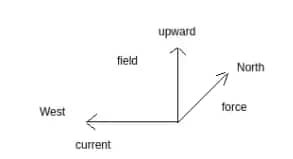
Keeping the thumb, forefinger and middle finger in mutually perpendicular directions. The middle finger represents the direction of the current (in the direction of motion of positive charge: towards the West), the thumb represents the force (towards the North), and then the forefinger represents the direction of the field (upward)
The direction of the Magnetic field will be upward.
Hence, option (d) is the correct answer.
Topic 12.4, Page Number - 205
Q.1 State Fleming’s left-hand rule
Answer:
Fleming's Left-Hand Rule:
Whenever a current-carrying conductor is placed in a magnetic field, the conductor experiences a force that is perpendicular to both the magnetic field and the direction of the current.
In other words,
If the first three fingers(Thumb, forefinger and middle finger) of the left hand are held mutually at right angles to each other, if the forefinger indicates the direction of the original field, and if the middle finger indicates the direction of the current flowing through the conductor, then the thumb indicates the direction of the force exerted on the conductor
Q.2 What is the principle of an electric motor?
Answer: When a current-carrying conductor is placed in a magnetic field, it experiences a force that is perpendicular to both the magnetic field and the direction of current through the conductor. So, the force helps the conductor in performing the rotation. The electric motor uses this principle to rotate.
Q.3 What is the role of the split ring in an electric motor?
Answer: The split ring is also called a commutator because it commutes (transfers) the current from the outside of the motor to the inside of the motor. It changes the direction of the current after every half rotation so that the motor will continue to rotate in the same direction.
Q.4 Explain different ways to induce a current in a coil.
Answer: Whenever we move a magnet towards the coil, a current will be induced. Also, when we move the loop towards the magnet, a current will be induced.
Confused between CGPA and Percentage?
Get your results instantly with our calculator!
NCERT Solutions for Class 10 Science Chapter 12: Additional In-text Questions
The additional in-text questions of Chapter 12, Magnetic Effects of Electric Current, offer extra practice to strengthen your concepts. These Magnetic Effects of Electric Current class 10 question answers cover important applications like electromagnets, electric motors, and current-carrying conductors, helping students build a deeper understanding and confidence for exams.
Q.1 State the principle of an electric generator.
Answer:
An electric generator works on the principle of electromagnetic induction. When the magnetic field around a conductor is changed, the generation of electric current happens in a circuit; this phenomenon is called electromagnetic induction. When we rotate a coil in a magnetic field, a current is induced in the coil (the circuit of the coil must be closed to utilise the current). The direction of the induced current is given by Fleming's right-hand rule.
Q.2 Name some sources of direct current.
Answer: The DC current is the current which does not change direction with time. The sources of DC current are a DC battery and a DC generator.
Q.3 Which sources produce alternating current?
Answer: Alternating current is the current which alternates direction at some time interval. Some sources of this type of current are AC generators and AC-producing power plants.
Q.4. Choose the correct option.
Answer: The direction of the induced current changes once in each half-revolution, since the direction of the relative motion of the coil and the magnetic field changes in every half-cycle
Hence, the correct option is (c).
Q.5 Name two safety measures commonly used in electric circuits and appliances.
Answer:
Two safety measures commonly used in electric circuits and appliances are
1) Use of an Electric Fuse: We add an electric fuse in series with our circuit to protect our circuit in the event that the current through the circuit becomes extremely high. When the current is high fuse breaks and the circuit gets isolated from the supply.
2) Earthing to prevent shock: We connect a proper ground connection so that whenever there is any leakage current in any appliance, it directly gets transferred to the ground without giving a shock to the person using the appliance.
Answer: As given in the question, the maximum current which can pass through an electric oven is 5 A. So let's find out how much current will pass through the device in the given power ratings.
So for power, we have a relation
Power (P) = Voltage(V) X Current (I)
So, putting the given values, we get
$
2 \mathrm{~kW}=220 \mathrm{V} \times \text { Current }(\mathrm{I})
$
$
\operatorname{Current}(I)=\frac{2000}{220} A=\frac{100}{11} A=9.09 A
$
As we can see, the current flowing in the electric oven is 9.09 A, which is greater than 5 A. This can be a dangerous situation. The insulation on the wire may melt and cause a short circuit. We use a fuse to protect us from this situation. A fuse is just a wire that melts and breaks the circuit in the case of an overcurrent situation like the above.
Q.7 What precautions should be taken to avoid the overloading of domestic electric circuits?
Answer: Some precautions that should be taken to avoid the overloading of domestic electric circuits are:
1) We should not use too many appliances at the same time.
2) We should not connect too many appliances to a single socket.
3) We should use the fuse for precaution when there is an overload.
4) We should not connect the faulty appliances in the circuit.
5) Proper earthing should be there
Class 10 Science Chapter 12 - Magnetic Effects of Electric Current: Exercise Solutions
Magnetic Effects of Electric Current NCERT Solutions (Exercise questions) include step-by-step, detailed answers to the questions that are given in the textbooks. The Magnetic Effects of Electric Current class 10 question answers assist students when covering important concepts such as the magnetic field and the right-hand thumb rule, thereby simplifying exam preparation and facilitating better results.
Q. 1 Which of the following correctly describes the magnetic field near a long straight wire?
(a) The field consists of straight lines perpendicular to the wire
(b) The field consists of straight lines parallel to the wire
(c) The field consists of radial lines originating from the wire.
(d) The field consists of concentric circles centred on the wire.
Answer:
The magnetic field lines around any current-carrying wire are concentric circles in nature, the centre of whose circle lies in the wire.
Hence, option (d) is correct.
Q. 2. At the time of the short circuit, the current in the circuit
Answer:
At the time of the short circuit, the current in the circuit increases abruptly.
Hence, option (c) is correct.
Q. 3. State whether the following statements are true or false.
(b) A wire with green insulation is usually the live wire of an electric supply.
Answer:
a)True, as the long circular coil is equivalent to a solenoid. and hence the field at the centre of a long circular coil carrying current will be parallel straight lines.
b) False, As the live wire in domestic circuits is usually red in colour and the ground wire is in green colour, NORMALLY.
Q. 4. List two methods of producing magnetic fields.
Answer:
The two methods of producing the magnetic field are:
1) Passing the current through any conductor.
2) The permanent magnet also produces a magnetic field around it.
Q. 5. When is the force experienced by a current-carrying conductor placed in a magnetic field largest?
Answer:
In the current-carrying conductor, the force experienced will be maximum when the direction of the current in the conductor is perpendicular to the magnetic field.
Answer:
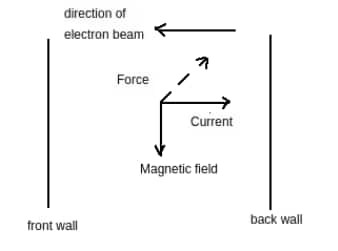
Suppose you are leaning towards the back wall, then the electron beam is moving away from your eyes, which means the direction of current is towards you (direction of current is taken opposite to the flow of electrons), and the deflection is to the right. Then, by Fleming's left-hand rule, the field is in the downward direction.
Q.7(a). State the rule to determine the direction of a magnetic field produced around a straight conductor-carrying current
Answer: To find the magnetic field produced around a straight conductor carrying current, we use Maxwell's Right-Hand thumb rule.
According to this rule, imagine that you are holding a current-carrying wire in your right hand so that the thumb points in the direction of the current, and then the direction in which the fingers wrap the wire will represent the direction of magnetic lines of force.
Q.7(b). State the rule to determine the direction of a force experienced by a current-carrying straight conductor placed in a magnetic field which is perpendicular to it
Answer: To find the force experienced by a current-carrying straight conductor placed in a magnetic field which is perpendicular to it, we use Fleming's Left-Hand Rule.
It states that if the first three fingers of the left hand are held mutually at right angles to each other, if the index finger indicates the direction of the original field, and if the middle finger indicates the direction of current flowing through the conductor, then the thumb indicates the direction of force exerted on the conductor.
Q.7(b). State the rule to determine the direction of a current induced in a coil due to its rotation in a magnetic field.
Answer: To find the current induced in a coil due to its rotation in a magnetic field, we use Fleming's Right-hand rule.
It states that the direction of the induced current (indicated by the Middle Finger) is perpendicular to both the direction of the magnetic field from the North pole to the South pole (indicated by the Index Finger) and the direction of movement or motion (indicated by the Thumb)
Q. 8. When does an electric short circuit occur?
Answer: The short circuit happens when the positive voltage point of the wire comes in contact with the negative voltage point in the wire. As the resistance of wires is very small, a very high current flows through the circuit, which can potentially damage the circuit. This phenomenon is called a short circuit.
When the neutral wire and live wire come in contact, a short circuit happens.
Also, when we connect too many appliances in a single circuit, the resistance of the circuit can get very small, up to the point of the possibility of having a short circuit.
Q. 9. What is the function of an earth wire? Why is it necessary to earth metallic appliances?
Answer: The main function of the earth wire is to prevent the live wire from overloading and absorb the excess electrons & flow beneath the ground. It is necessary because it prevents electrical appliances from getting damaged and absorbs the excess electricity from appliances.
In other words, whenever we have a connection to the ground, the leakage current or the overload current can be transferred to the ground directly, and the events of shock can be prevented in which the current passes through the body of the person touching the metallic appliances.
NCERT Solutions for Class 10 Science Chapter 12: Additional Questions
The additional questions of Chapter 12, Magnetic Effects of Electric Current, are designed to give students extra practice beyond the textbook. These questions cover application-based and conceptual problems that improve problem-solving skills and boost confidence for exams.
Q. 1. The phenomenon of electromagnetic induction is
(a) the process of charging a body.
(b) the process of generating a magnetic field due to a current passing through a coil.
(c) producing induced current in a coil due to relative motion between a magnet and the coil.
(d) the process of rotating a coil of an electric motor
Answer:
Electromagnetic induction is the phenomenon of producing an induced current in a coil by changing the magnetic field.
Hence, the phenomenon of electromagnetic induction produces an induced current in a coil due to the relative motion between a magnet and the coil.
Hence, option (c) is the correct answer.
Q. 2. The device used for producing electric current is called a
Answer:
We produce current in the generator, so the device used for producing electric current is called a Generator. It converts mechanical energy into electrical energy.
Q. 3. The essential difference between an AC generator and a DC generator is that
(a) An AC generator has an electromagnet while a DC generator has a permanent magnet.
(b) DC generator will generate a higher voltage.
(c) AC generator will generate a higher voltage.
(d) AC generator has slip rings while the DC generator has a commutator.
Answer:
In a DC generator, we have two split rings, also known as a commutator, to prevent the change in direction of the current. While in AC, we want the direction to be changed, so we use normal slip rings to transfer current from the inside of the generator to the outside of the generator. This is the main difference between the AC generator and the DC generator.
Hence, option (d) is the correct answer.
Answer:
A solenoid is a long coil of a circular loop of any conductor. The magnetic field lines inside the solenoid are parallel to each other, just like in a permanent magnet.
The magnetic field lines outside the solenoid are also similar to those of the permanent magnet. Hence, we can assume the end from where the field lines emerge as the North Pole and the end where the field lines merge as the South Pole.
When we bring the North pole of a bar magnet towards one side of the solenoid, if it repels the side of the solenoid is North and if it attracts, then the side of the solenoid is South. The polarity of the other side will be opposite.
Answer:
A simple Electric Motor :
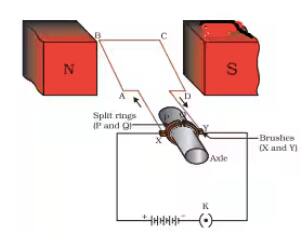
An electric motor converts electrical energy into mechanical energy.
Principle: It works on the principle of the magnetic effect of the current. When a current-carrying conductor is placed in the magnetic field, it experiences a force and starts moving.
Working :
An electric motor, as shown, consists of a rectangular coil ABCD of insulated copper wire. The coil is placed between the two poles of a magnetic field such that the arms AB and CD are perpendicular to the direction of the magnetic field. The ends of the coil are connected to the two halves, P and Q, of a split ring. The inner sides of these halves are insulated and attached to an axle. The external conducting edges of P and Q touch two conducting stationary brushes X and Y, respectively.
Current in the coil ABCD enters from the source battery through conducting brush X and flows back to the battery through brush Y. Notice that the current in arm AB of the coil flows from A to B. In the arm CD, it flows from C to D, that is, opposite to the direction of current through arm AB. On applying Fleming’s left-hand rule for the direction of the force on a current-carrying conductor in a magnetic field. We find that the force acting on arm AB pushes it downwards while the force acting on arm CD pushes it upwards. Thus, the coil and the axle O are mounted free to turn about an axis and rotate counterclockwise. At half rotation, Q makes contact with brush X and P with brush Y. Therefore, the current in the coil gets reversed and flows along the path DCBA.
A device that reverses the direction of flow of current through a circuit is called a commutator. In electric motors, the split ring acts as a commutator. The reversal of the current also reverses the direction of force acting on the two arms AB and CD. Thus, the arm AB of the coil that was earlier pushed down is now pushed up, and the arm CD previously pushed up is now pushed down. Therefore, the coil and the axle rotate half a turn more in the same direction. The reversing of the current is repeated at each half-rotation, giving rise to a continuous rotation of the coil and the axle.
The split ring helps in reversing the direction of current in the armature so that it rotates continuously in one direction.
Q. 6. Name some devices in which electric motors are used.
Answer: We use electric motors in many devices like fans, pumps, grinders, washing machines, vehicles and many more.
Q. 7. A coil of insulated copper wire is connected to a galvanometer. What will happen if a bar magnet is
(ii) withdrawn from inside the coil
(iii) held stationary inside the coil?
Answer:
(i) When a bar magnet is pushed into the coil, there is a relative motion between the magnetic field and the coil; hence, a current will be induced, which will deflect the galvanometer. When the bar magnet is inside the coil and not moving, the flux won't change, so the galvanometer won't show deflection. And hence Overall galvanometer will deflect momentarily.
(ii) When the bar magnet is being removed, the flux through the coil will change, which results in inducing the current and deflecting the galvanometer. After the bar magnet is completely removed and is at a sufficiently large distance for its magnetic field to affect the coil, there won't be any flux change in the coil, and hence no current will be induced. And hence, overall, the galvanometer will deflect momentarily.
(iii) If a bar magnet is held stationary inside the coil, the flux through the coil is not changing with time, and hence there won't be any induced current. Therefore, the galvanometer won't show any deflection.
Answer: When the two circular coils A and B are placed close to each other, and the current in coil A is changed, the magnetic field coil A is producing will change, which leads to the current in coil B.
Answer: The Electric Generator:
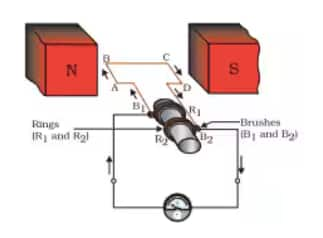
An electric generator converts mechanical energy into electrical energy.
Principle: It works on the principle of electromagnetic induction. Whenever there is a change in the flux through any coil, there is the induction of current.
Working:
An electric generator, as shown, consists of a rotating rectangular coil ABCD placed between the poles of a permanent magnet. The two ends of this coil are connected to the two rings R1 and R2. The inner side of the ring is insulated. The two conducting stationary brushes B1 and B2 are kept pressed separately on the rings R1 and R2, respectively. The two rings R1 and R2 are internally attached to an axle. The axle may be mechanically rotated from the outside to rotate the coil inside the magnetic field. The outer ends of the two brushes are connected to the galvanometer to show the direction of the flow of current in the external circuit. When the axle attached to the two rings is rotated such that the arm AB moves up (and the arm CD moves down) in the magnetic field produced by the permanent magnet. Let us say the coil ABCD is rotated clockwise in the arrangement shown. By applying Fleming’s right-hand rule, the induced currents are set up in these arms along the directions AB and CD.
Thus, an induced current flows in the direction ABCD. This means that the current in the external circuit flows from B2 to B1. After half a rotation, arm CD starts moving up and AB moving down. As a result, the directions of the induced currents in both arms change, giving rise to the net induced current in the direction of DCBA. The current in the external circuit now flows from B1 to B2. Thus, after every half rotation, the polarity of the current in the respective arms changes. Such a current, which changes direction periodically, is called alternating current (AC). This device is called an AC generator.
To get a direct current (DC, which does not change its direction with time), a split-ring type commutator must be used. With this arrangement, one brush is at all times in contact with the arm moving up in the field, while the other is in contact with the arm moving down
The function of Brushes: Brushes help in transferring the current from inside the generator to the external circuit.
Class 10 Science Chapter 12 - Magnetic Effects of Electric Current: Higher Order Thinking Skills (HOTS)
The HOTS questions in Class 10 Science Chapter 12 - Magnetic Effects of Electric Current are carried out in order to examine analytical thinking and practical application of principles of magnetic field, electromagnetic induction, and the principle of a motor. These are the questions to solve and develop critical thinking skills, as well as train in preparing for competitive exams.
Q1. The magnetic lines of force inside a bar magnet
a) are from north pole to south pole of the magnet
b) do not exist
c) depend upon the area of cross section of the bar magnet.
d)are from south pole to north pole of the magnet.
Answer:
The magnetic lines of force inside a bar magnet are from the south pole to the north pole of the magnet.
Q.2 A negative test charge is moving near a long straight wire carrying a current. The force acting on the test charge is parallel to the direction of the current. The motion of the charge is :
a)away from the wire
b) towards the wire
c) parallel to the wire along the current
d) parallel to the wire, opposite to the current
Answer:
The direction of force on a charged particle in a magnetic field can also be found by Fleming's left-hand rule
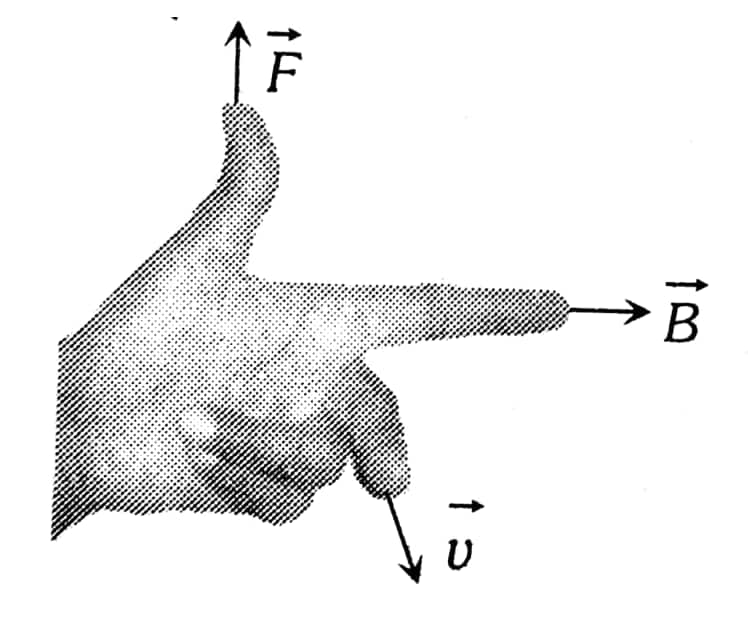
$\vec{F}=q(\vec{\nu} \times \vec{B})$
According to Fleming's left-hand rule, the direction of motion of the charge is towards the wire.
Hence, the answer is option (b).
Q3. The magnetic field inside a 200-turn solenoid of radius 10 cm is $2.9 \times 10^{-4} \mathrm{Tesla}$. If the solenoid carries a current of 0.29 A , then the length of the solenoid is_____$\pi \mathrm{cm}$.
Answer:
Assuming a long solenoid
$
\begin{aligned}
& \mathrm{B}=\mu_0\left(\frac{\mathrm{~N}}{\ell}\right) \mathrm{i} \\
& \ell=\frac{\mu_0 \mathrm{Ni}}{\mathrm{~B}}=\frac{\left(4 \pi \times 10^{-7}\right)(200)(0.29)}{2.9 \times 10^{-4}} \mathrm{~m} \\
& \ell=8 \pi \mathrm{~cm}
\end{aligned}
$
Q4. The magnetic field $B$ inside a long solenoid carrying a current of 10 A is $3.14 \times 10^{-2} \mathrm{~T}$. Find the no of turns per unit length of the Solenoid.
Answer:
For a solenoid having n turns, then the magnetic field, $B=\mu_0 n i$
$\begin{aligned}
& \Rightarrow 3.14 \times 10^{-2}=4 \pi \times 10^{-7} \times n \times 10 \\
& \Rightarrow n=\frac{3.14 \times 10^{-2}}{4 \pi \times 10^{-7} \times 10} \\
& \Rightarrow n=2500 \text { turns } / \mathrm{m}
\end{aligned}$
Hence, the answer is 2500 turns
Q5. Two long parallel wires 1 and 2 separated by a distance d carry equal currents I, as shown in Fig. The magnetic field at the point p, which is exactly midway between the two wires, is.

Answer:
The magnitude of the magnetic field at a point at a distance r from a long wire carrying a current I is given by:
$\mathrm{B}=\frac{\mu_0 \mathrm{I}}{2 \pi \mathrm{r}}$
Therefore, the magnitude of the magnetic field at point $P$ is due to the current in wire 1 (since $r=d / 2$ ).
$\mathrm{B}_1=\frac{\mu_0 \mathrm{I}}{2 \pi(\mathrm{~d} / 2)}=\frac{\mu_0 \mathrm{I}}{\pi \mathrm{~d}}$
From the right-hand thumb rule, the direction of the field is into the page. For wire 2,
$\mathrm{B}_2=\frac{\mu_0 \mathrm{I}}{\pi \mathrm{~d}} \quad \text { out of the page }$
These two fields have equal magnitude but opposite directions. Hence, they cancel each other.
Q6: Electric supply of a house is through a 15 -A fuse. When a 2000 -W heater is used in this house, how many 100 -W bulbs can be used simultaneously? The supply is at 220 V , and the heater and the bulbs are rated for 220 V.
Answer:
Given - Current $(\mathrm{I})=15 \mathrm{~A}$, domestic supply $(\mathrm{V})=220 \mathrm{~V}$, power of heater $\left(\mathrm{P}_1\right)=2000 \mathrm{~W}$, and power of bulb $\left(\mathrm{P}_2\right)=100 \mathrm{~W}$
- The maximum power the household circuit can hold,
$
\begin{aligned}
& \Rightarrow P=V I \\
& \Rightarrow P=220 \times 15=3300 \mathrm{~W}
\end{aligned}
$
- Let n be no of bulbs that can be used in the circuit, then
$
\begin{aligned}
& \Rightarrow P=n P_1+P_2 \\
& \Rightarrow 3300=n \times 100+2000 \\
& \Rightarrow n \times 100=3300-2000=1300 \\
& \Rightarrow n=13
\end{aligned}
$
Q7:
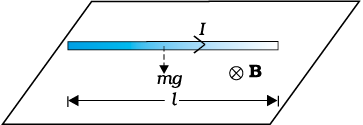
A straight wire of mass 200 g and length 1.5 m carries a current of 2 A. It is suspended in mid-air by a uniform horizontal magnetic field B. What is the magnitude of the magnetic field?
Answer:
From Fleming's left-hand rule, we find that the magnetic force is in the upward direction, of magnitude ILB. For mid-air suspension, this must be balanced by the force due to gravity:
And the magnetic field and current are perpendicular to each other, so \theta=90 degrees
So, magnetic force=mg
$\begin{aligned}
& m g=I l B \\
& B=\frac{m g}{I l} \\
& \Rightarrow B=\frac{0.2 \times 9.8}{2 \times 1.5}=0.65 \mathrm{~T}
\end{aligned}$
Magnetic Effects of Electric Current NCERT Solutions: Important Topics
Chapter 12- Magnetic Effects of Electric Current has several important topics, including the magnetic field caused by current, the right-hand thumb rule, electromagnetic induction and domestic electric circuits. These are the significant areas that provide a foundation for higher knowledge and are needed to prepare for examinations.
12.1 Magnetic Field And Field Lines
12.2 Magnetic Field Due To A Current-Carrying Conductor
12.2.2 Right-Hand Thumb Rule
12.2.3 Magnetic Field Due To A Current Through A Circular Loop
12.2.4 Magnetic Field Due To A Current In A Solenoid
12.3 Force On A Current-Carrying Conductor In A Magnetic Field
12.4 Domestic Electric Circuits
NCERT Solutions for Class 10 Science Chapter 12: Important Formulas
Chapter 12, Magnetic Effects of Electric Current, has some important formulas involving the strength of the magnetic field and the magnetic field due to a solenoid. These equations are essential to solving numerical problems and grasping real-life problems, such as generators and motors.
1. Magnetic Field Due to a Straight Current-Carrying Conductor
Magnetic field B around a straight conductor is directly proportional to the current and inversely proportional to the distance from the conductor:
$B \propto \frac{I}{r}$
2. Right-Hand Thumb Rule
When the right-hand thumb points in the direction of the current, the curled fingers show the direction of the magnetic field.
3. Magnetic Field Inside a Solenoid
$
B \propto n I
$
Where:
$
\begin{aligned}
& B=\text { magnetic field } \\
& n=\text { number of turns per unit length } \\
& I=\text { current through the solenoid }
\end{aligned}
$
Also Read,
NCERT Class 10 Science Solutions Chapter 12 - Weightage in Board Exams
In the Class 10 board exam, the chapter "Magnetic Effects of Electric Current" holds considerable importance with a weightage of almost 10 marks, accounting for around 12.5% of the total marks in the Science exam. This chapter is significant as questions related to it can be found in both the objective and subjective sections of the exam. Students must thoroughly prepare for this chapter to perform well and secure good marks in the board examination. Studying the NCERT Solutions for Class 10 Science Chapter 12 can prove beneficial in comprehending the concepts and answering questions effectively.
Approach to Solve Questions of the Magnetic Effect Of Electric Current
The chapter on Magnetic Effects of Electric Current assists the students to discuss how electricity and magnetic effects are related in areas such as magnetic field lines, electromagnets and how electric motors work. In order to answer questions in this chapter, students are advised to put emphasis on the right-hand thumb rule, the direction of the magnetic fields, and the left-hand and right-hand rules of Fleming. With a systematic process, it becomes easier to deal with the theory and numerical problems.
- Begin by reading the chapter and understanding that when an electric current is present, a magnetic field is generated around it.
- Understand what magnetic field lines are and how to draw them to demonstrate the direction of the field.
- Understand and apply the Right-Hand Thumb Rule to find the direction of the magnetic field around a current-carrying conductor.
- Experiment with the field of current about a straight wire, a circle and a solenoid and observe the differences and similarities.
- You can use diagrams wherever you can to make your answers clear and visually correct.
- Concentrate on the phenomenon of electromagnetism and the way a solenoid is similar to a bar magnet.
- Re-read all definitions, laws and rules stated in the chapter to get the right answers.
- Solve NCERT exercise questions and sample problems regularly to build confidence and improve understanding.
Also, Check NCERT Solution for class 10
Benefits of NCERT Solutions Class 10 Chapter 12: Magnetic effects of electric current
The NCERT Solutions of Class 10 Science Chapter 12- Magnetic Effects of Electric Current make students have a clear vision of how electric current can create a magnetic field and how it influences the magnets and moving charges. These class 10 science Magnetic Effects of Electric Current question answers make complicated concepts, such as the right-hand thumb rule, electromagnetism, simpler. Through step-by-step responses provided in a detailed manner, the students will have the capability of strengthening their conceptual knowledge and enhancing their performance in exams.
- Conceptual Clarity- Solutions include explanations of concepts such as magnetic field, right-hand thumb rule, electric motor, etc., in simple language.
- Step-by-Step Solutions - Questions are answered in step-by-step format, so that students understand the reasoning behind the solutions.
- Exam-Oriented Preparation- It incorporates all the NCERT practical and exercise questions which are commonly asked in the CBSE boards examination.
- Supports HOTS & Competitions- Provides reasoning and higher thinking skills questions that are practical in Olympiads and NTSE.
- Enhances Problem-Solving Abilities- Conceptual learning is enhanced by practical examples and numerical questions.
- Saves Time in Revision - Simplified solutions and formulae can assist in last-minute revisions before the exams..
How Can NCERT Solutions for Class 10 Science Chapter 12 Help in Exam Preparation?
The NCERT Solutions for Class 10 Science Chapter 12 - Magnetic Effects of Electric Current help students prepare effectively for exams by making complex concepts easy to understand. These solutions describe significant concepts such as magnetic field lines, the right-hand thumb rule, the left-hand rule (Fleming) and how solenoids work in a step-by-step way. They instruct students on how to write concise and specific answers as required in board exams. The answers to all NCERT in-text and exercise questions solidify the conceptual information and enhance the accuracy of problem-solving in the students. Diagram-based explanations are also included in the solutions, and they assist in visual learning and achieving better scores in exams. The frequent use of these solutions provides confidence, assures revision of important formulas and laws and enables students to excel in CBSE board examinations and competitive exams.
What You Will Learn from NCERT Solutions for Class 10 Science Chapter 12: Magnetic Effects of Electric Current?
The students in this chapter gain a nice idea about the magnetic effects of electric current and their importance in the real world. Students will learnthe following important points about this chapter by using Class 10 Science chapter 12 Magnetic Effects of Electric Current solutions:
- The chapter enables the students to know how electric current generates a magnetic field, and the factors influencing the strength and direction of the magnetic field.
- Students are taught about the magnetic field lines, the right-hand thumb rule and the left-hand and right-hand rules in very simple and clear explanations and examples.
- With Magnetic Effects of Electric Current Class 10 question answers, the students will have a good knowledge of the force that acts on a conductor carrying a current and placed in a magnetic field.
- The chapter is very clear in explaining electromagnetic induction, electric motors, and generators, and their mechanism of operation.
NCERT Solutions for Class 10 Science: Chapter Wise
NCERT Class 10 Science Solutions include proper and comprehensive answers to every chapter, and can make exam preparation much easier and effective. These are chapter-wise solutions which include the Physics, Chemistry and Biology concepts in step-by-step explanation and pattern, which is more understandable and practice not only in board exams but also in any competitive tests.
NCERT Solutions for Class 10: Subject Wise
NCERT Solutions for Class 10 Maths and Science provide clear, accurate, and step-by-step answers to textbook questions based on the latest syllabus. These subject-wise solutions help students strengthen concepts, improve problem-solving skills, and prepare confidently for board examinations.
NCERT Notes for Class 10: Subject Wise
NCERT Notes for Class 10 Maths and Science offer concise and well-organised explanations of important concepts, formulas, and diagrams. These subject-wise notes help students revise quickly, improve conceptual clarity, and strengthen exam preparation.
NCERT Books and Syllabus
NCERT Books and the NCERT Syllabus for Class 10 form the core of the CBSE curriculum and ensure concept-based learning. Easy access to these links helps students follow the prescribed textbooks, understand the exam pattern, and prepare systematically for board examinations.
Frequently Asked Questions (FAQs)
Yes, this chapter is useful for higher studies in the science field. If you are choosing Science in Class 12, then there are chapters based on the concepts studied in NCERT Class 10 Science Chapter 12 Magnetic Effects of Electric Current.
It shows the ability of electric current to generate magnetic fields and how these are utilized in devices such as the electromagnets and in motor devices.
Magnetic Field, Force on a Current-Carrying Conductor, Electric Motor, Electromagnetic Induction, Electric Generator, Right Hand Thumb Rule, Flemings Left and Right Hand Rule etc are some of the important topics.
It assists in finding out the direction of force through a current carrying conductor or in a magnetic field.
Yes, it is a test chapter having theory, diagrams and questions based on concepts which are commonly asked.
This chapter tells how an electric current produces a magnetic field and explores its applications in devices like electric motors, generators, and transformers.
The solutions offer detailed step-by-step descriptions, allowing conceptual clarity and aiding students to efficiently solve numerical questions.

Questions related to CBSE Class 10th
On Question asked by student community
Hello Aspirant, Hope your doing great, your question was incomplete and regarding what exam your asking.
Yes, scoring above 80% in ICSE Class 10 exams typically meets the requirements to get into the Commerce stream in Class 11th under the CBSE board . Admission criteria can vary between schools, so it is advisable to check the specific requirements of the intended CBSE school. Generally, a good
hello Zaid,
Yes, you can apply for 12th grade as a private candidate .You will need to follow the registration process and fulfill the eligibility criteria set by CBSE for private candidates.If you haven't given the 11th grade exam ,you would be able to appear for the 12th exam directly
According to cbse norms candidates who have completed class 10th, class 11th, have a gap year or have failed class 12th can appear for admission in 12th class.for admission in cbse board you need to clear your 11th class first and you must have studied from CBSE board or any
Yes, you can definitely apply for diploma courses after passing 10th CBSE. In fact, there are many diploma programs designed specifically for students who have completed their 10th grade.
Generally, passing 10th CBSE with a minimum percentage (often 50%) is the basic eligibility for diploma courses. Some institutes might have