


NCERT Solutions for Class 10 Science Chapter 10 - The Human Eye and The Colorful World
Have you ever wondered why the sky is blue in the daytime and reddish-orange in the sunrise and at sunset, or why we can only see the stars shining at night? All these interesting phenomena of the natural world are described in Chapter 10 Science Chapter 10 - The Human Eye and the Colourful World. The key topics discussed in this chapter include how the eye works, the structure and the necessities of the human eye, the different common conditions of the eye that are corrected by lenses, the refraction of light in the atmosphere, white light dispersion and scattering of light.
This Story also Contains
- NCERT Solutions for Class 10 Science Chapter 10 - Human Eye and Colourful World: Download PDF
- Class 10 Science Chapter 10 - Human Eye and Colourful World: Intext Solutions
- Human Eye and Colourful World NCERT Solutions: Exercise Questions
- Class 10 Science Chapter 10 - Human Eye and Colourful World: Higher Order Thinking Skills (HOTS)
- NCERT Solutions for Class 10 Science Chapter 10 - Human Eye and Colourful World: Topics
- Class 10 Science Chapter 10 - Human Eye and Colourful World: Important Formulae
- Approach to Solve Questions of Class 10 Science Chapter 10 - Human Eye and Colourful World
- Benefits of the Human Eye and Colourful World Class 10 Question Answers
- How Can NCERT Solutions for Class 10 Science Chapter 10 Help in Exam Preparation?
- What You Will Learn from NCERT Solutions for Class 10 Science Chapter 10: The Human Eye and the Colourful World?
- NCERT Solutions for Class 10 Science: Chapter Wise
- NCERT Solutions for Class 10 Subject Wise
- NCERT Notes for Class 10 Subject Wise
- NCERT Books and Syllabus

NCERT Solutions for Class 10 Science Chapter 10 - Human Eye and Colourful World give a step-by-step explanation to every in-text and exercise question so that students develop a good conceptual knowledge. These NCERT solutions not only eliminate the common misunderstandings but also make learning exciting by giving real-world examples of some natural phenomena. These NCERT Solutions for Class 10 Science Chapter 10 - Human Eye and Colourful World have been prepared as per the recent CBSE syllabus and contain HOTS questions, topics, and downloadable PDFs to enable the students to revise better, reinforce preparation to examine better and confidently appear in their board exams and other competitive exams.
NCERT Solutions for Class 10 Science Chapter 10 - Human Eye and Colourful World: Download PDF
With step-wise answers to all questions in the textbook, the Human Eye and Colourful World NCERT Solutions will make students understand the main points. These class 10 science chapter 10 Human Eye and Colourful World question answers are provided in the form of a free downloadable PDF, which is convenient and easy to revise.
Class 10 Science Chapter 10 - Human Eye and Colourful World: Intext Solutions
Human Eye and Colourful World NCERT Solutions: Human Eye and the Colourful World (Intext Questions) offers precise explanations by illustrated diagrams to enable students to study certain principles involved in eye functioning, defects of the eyes, atmospheric refraction, and dispersion of light. These step-by-step class 10 science chapter 10 Human Eye and Colourful World question answers enhance clarity of concepts and help in exam preparation.
Topic 10.2 - Defects of vision and their correction
Q.1. What is meant by the power of accommodation of the eye?
Answer:
The power of accommodation is the ability of an eye to focus near and far objects clearly and make the image on the retina by adjusting its focal length. However, the focal length of the eye lens cannot be decreased below a certain minimum limit.
Answer:
The correction for a myopic eye should be the concave lens (negative power) to restore proper vision.
Q.3. What are the far point and near point of the human eye with normal vision?
Answer:
The far point of the human eye with normal vision is at infinity, and the near point is 25cm from the eye.
Answer:
Since the student has difficulty reading the blackboard while sitting in the last row, he is most likely to suffer from myopia (short-sightedness), i.e., he can see objects clearly but is unable to see distant objects properly.
Hence, it can be corrected by placing the spectacles with concave lenses of appropriate power.
Human Eye and Colourful World NCERT Solutions: Exercise Questions
Human Eye and Colourful World Class 10 question answers (Exercise Questions) offer well-structured answers to all textbook questions. These Human Eye and Colourful World class 10 question answers simplify complex topics like vision, refraction, rainbow formation, and scattering of light, making them easier to understand and revise for exams
(a) presbyopia
(b) Accommodation
(c) near-sightedness
(d) far-sightedness
Answer:
It is due to the accommodation of the eye. The human eye can adjust its focal length according to the different distances. Therefore, option (b) is correct.
Q.2. The human eye forms the image of an object at its
Answer:
The human eye forms the image of an object on its retina. Therefore, the correct option is (d) Retina
Q.3. The least distance of distinct vision for a young adult with normal vision is about
Answer:
The least distance of distinct vision for a young adult with normal vision is about (c) 25 cm
Q.4. The change in focal length of an eye lens is caused by the action of the
Answer:
The change in focal length of an eye-lens is caused by the action of the :(c) ciliary muscles
Answer:
For the distant vision:
The power of the lens, given $P=-5.5 \mathrm{D}$
$
\operatorname{Power}(\text { in } D)=\frac{1}{f(m)}
$
Hence, the focal length will be:
$
f=\frac{100}{-5.5}=-18.2 \mathrm{~cm}
$
Therefore, the focal length of the lens required for correcting distant vision will be: -18.2 cm (Here, the negative sign of focal length tells us that it is a concave lens).
For near vision:
The power of the lens, given $P=+1.5 \mathrm{D}$
$
\operatorname{Power}(\text { in } D)=\frac{1}{f(m)}
$
Hence, the focal length will be:
$
f=\frac{100}{+1.5}=66.66 \mathrm{~cm}
$
Therefore, the focal length of the lens required for correcting near vision will be: +66.7 cm (Here, the positive sign of focal length tells us that it is a convex lens).
Answer:
The myopic person is suffering from near-sightedness, which can be corrected by putting a concave lens in spectacles.
Given that the far point up to which a myopic person can see is 80cm in front of the eye.
Here, this person can see the distant object (kept at infinity) clearly if the image of this distant object is formed at his far point.
So, we have
The object distance, $u=\infty$ (in finity $)$
The image distance, $v=-80 \mathrm{~cm}$ (far point, in front of the lens).
Hence, substituting the values in the lens formula, we obtain
$
\begin{aligned}
& \frac{1}{v}-\frac{1}{u}=\frac{1}{f} \\
& \Rightarrow \frac{1}{-80}-\frac{1}{\infty}=\frac{1}{f} \\
& \Rightarrow \frac{1}{f}=\frac{1}{-80}
\end{aligned}
$
$ \Rightarrow f=-80 \mathrm{~cm}$
Therefore, the focal length of the required concave lens will be 80 cm
Now, Power,
$
\text { Power }=\frac{1}{f(m)}=\frac{1}{-0.8}=-1.25 \mathrm{D}
$
Hence, the power of the concave lens required is -1.25 D
Answer:
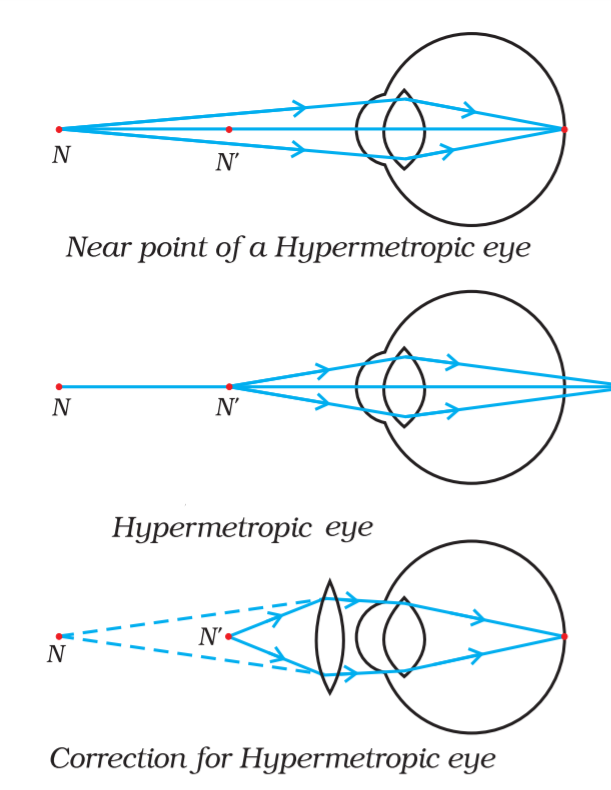
Given the near point for the hypermetropic eye is 1m.
Assume the near point of the normal eye is 25 cm.
So,
The object distance will be, $u=-25 \mathrm{~cm}$ (Normal near the point)
The image distance, $v=-1 m$ (Near the point of this defective eye) or -100 cm
Then the focal length can be found from the lens formula:
$
\frac{1}{v}-\frac{1}{u}=\frac{1}{f}
$
Substituting the values in the equation, we obtain
$
\begin{aligned}
& \Rightarrow \frac{1}{-100}-\frac{1}{-25}=\frac{1}{f} \\
& \Rightarrow \frac{-1+4}{100}=\frac{1}{f} \\
& \Rightarrow \frac{3}{100}=\frac{1}{f} \\
& \Rightarrow f=\frac{100}{3}=33.3 \mathrm{~cm} \text { or } 0.333 \mathrm{~m}
\end{aligned}
$
Hence, the power of the lens will be:
$
P=\frac{1}{f(m)}=\frac{1}{+0.333 \mathrm{~m}}=+3.0 \mathrm{D}
$
Thus, the power of the convex lens required will be +0.3 D
Q.8. Why is a normal eye not able to see clearly the objects placed closer than 25 cm?
Answer:
A normal eye is not able to see objects placed closer than 25 cm because the ciliary muscles have a limit of contraction and relaxation. To see closer objects, the ciliary muscles must decrease the focal length of the eye lens. However, the focal length of the eye lens cannot be decreased below a certain minimum limit. Due to this, our eyes are not able to see objects clearly when placed closer than 25cm.
Answer:
There is no change to the image distance in the eye when we increase the distance of an object from the eye. The image is always formed in the retina of our eye.
Q.10. Why do stars twinkle?
Answer:
Stars twinkle because of turbulence in the Earth's atmosphere of the Earth.
The light from the star is refracted in different directions because of the variable refractive index. This seems to us like the position of stars to be changed slightly, and also the brightness and position. Hence, the twinkling of stars happens.
Q.11. Explain why the planets do not twinkle.
Answer:
Planets do not twinkle the way stars do. The reason is that stars are so far away that they appear to be a point source of light on the sky, while planets have finite size and the size of a planet "averages out" the turbulent effects of the atmosphere.
Therefore, we see a relatively stable image of the eye. Hence, twinkling is not observed on planets.
Q.12. Why does the Sun appear reddish early in the morning?
Answer:
At sunrise and sunset, the sun is closer to the horizon. The sunlight near the horizon passes through denser layers of the air and covers a larger distance before reaching our eyes. Most of the blue light gets scattered. The light that reaches our eyes is of longer wavelengths, mainly orange and red. That is why the sun appears red at sunrise and at sunset.
Q.13. Why does the sky appear dark instead of blue to an astronaut?
Answer:
The dark colour is nothing but the absence of light.
The sky appears dark instead of blue to an astronaut because there is no atmosphere in outer space that can scatter the sunlight. As the sunlight is not scattered, no scattered light reaches the eyes of the astronauts the sky appears black to them.
Confused between CGPA and Percentage?
Get your results instantly with our calculator!
Class 10 Science Chapter 10 - Human Eye and Colourful World: Higher Order Thinking Skills (HOTS)
Class 10 Science Chapter 10 - Human Eye and Colourful World (HOTS Questions) will assess in-depth knowledge and concept application. The questions are not basic ones because they make students develop their own way of thinking about real-life phenomena, such as myopia, dispersion, and atmospheric refraction.
Q1: The angle of a prism is $30^{\circ}$, and its refractive index is $\sqrt{2}$, and one of the surfaces is silvered. At what angle of incidence should a ray be incident on one surface so that after reflection from the silvered surface, it retraces its path?
Answer:

$\begin{aligned} & \text { so } r_1+r_2=A \\ & \text { and } r_2=0 \\ & \text { Hence } r_1=30^{\circ} \\ & n_1 \sin i=n_2 \sin r \\ & \Rightarrow \sin i=(\sqrt{2})(1 / 2) \\ & i=45^{\circ}\end{aligned}$
Q2: One ray of light suffers minimum deviation in an equilateral prism P, additional prisms Q and R of identical shape and made up of the same material, as shown in the figure. The ray will now suffer ________

Answer:
Atmospheric refraction causes the sun to appear two minutes before it is actually above the horizon (advanced sunrise). Also, we can see the sun for about two minutes even after it is actually below the horizon (delayed sunset). Therefore, the time from sunrise to sunset is increased by about four minutes because of the refraction of light through the Earth's atmosphere. If the Earth had no atmosphere, the length of the day would have been shorter by about four minutes.
Q3: Which of the following are conditions necessary for observing a rainbow?
Answer:
A rainbow occurs due to reflection and refraction occurring from water droplets present in the air. So, to see a rainbow, it should have rained, and the Sun should be present.
At the same time, the Sun should be behind the observer. If it is otherwise, only the glare of the Sun will be felt, and no rainbow will be observed.
Q4: A beam of white light falls on a glass prism. The colour of light which undergoes the least bending on passing through the glass prism is :
Answer:
$\mu=\frac{\text { velocity of light in air or vacuum }}{\text { velocity of light in a given medium }}$
The refractive index of violet colour in the glass is greater than the refractive index of red; in other words, the speed of violet is the least in glass, and the speed of red is the highest. So, the red light bends the least while the violet bends the most.
Q5: By how much time would the day have been shorter if the Earth had no atmosphere?
Answer:
Atmospheric refraction causes the sun to appear two minutes before it is actually above the horizon (advanced sunrise). Also, we can see the sun for about two minutes even after it is actually below the horizon (delayed sunset). Therefore, the time from sunrise to sunset is increased by about four minutes because of the refraction of light through the Earth's atmosphere. If the Earth had no atmosphere, the length of the day would have been shorter by about four minutes.
Q6: Explain the refraction of light through a triangular glass prism using a labelled ray diagram. Hence, define the angle of deviation.
Answer:
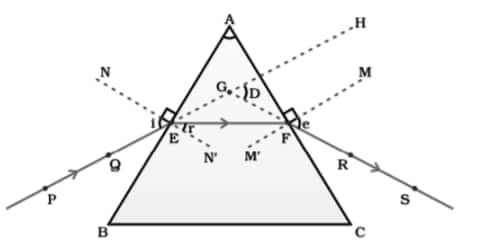
Here, PE is the incident ray, EF is the refracted ray, and FS is the emergent ray. A ray of light is entering from air to glass at the first surface AB. The light ray on refraction has bent towards the normal. At the second surface AC, the light ray has entered from glass to air. Hence, it has bent away from normal. The specific shape of the prism makes the emergent ray bend at an angle to the direction of the incident ray. This angle is called the angle of deviation. In this case, ∠ D is the angle of deviation. The angle between the incident ray and the emergent ray is called the angle of deviation.
PE $=$ Incident Ray
EF$=$ Refracted ray
FS $=$ Emergent ray
$\angle \mathrm{A}=$ Angle of the prism
$\angle \mathrm{i}=$ Angle of incidence
$\angle \mathrm{r}=$ Angle of refraction
$\angle \mathrm{e}=$ Angle of emergence
$\angle \mathrm{D}=$ Angle of deviation
Q7:
A ray of light is incident on an equilateral glass prism placed on a horizontal table. For minimum deviation which of the following is true ?
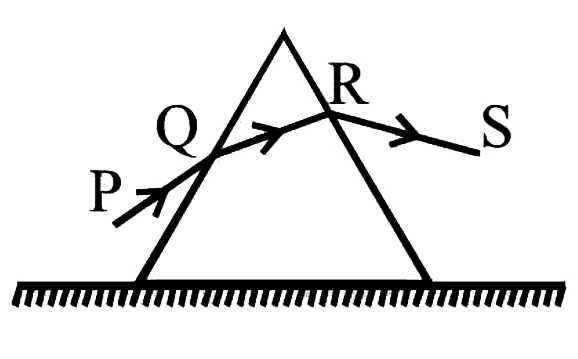
1. RS is horizontal
2. Either PQ or RS is horizontal
3. QR is horizontal
4. PQ is horizontal
Answer:
When the prism is in the position of minimum deviation, the ray inside the prism is parallel to base of the prism.
∴ QR is parallel to base.
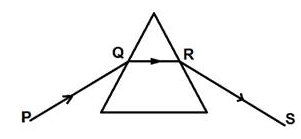
Hence, the answer is the option (3).
NCERT Solutions for Class 10 Science Chapter 10 - Human Eye and Colourful World: Topics
Class 10 Science Chapter 10 - Human Eye and Colourful World have all the important topics like the structure of the human eye, problems in vision, refraction in air, light scattering and formation of a rainbow. Students can learn the major concepts and successfully pass the exams with the use of these solutions.
10.1 The Human Eye
10.1.1 Power Of Accommodation
10.2 Defects Of Vision And Their Correction
10.3 Refraction Of Light Through A Prism
10.4 Dispersion Of White Light By A Glass Prism
10.5 Atmospheric Refraction
10.6 Scattering Of Light
10.6.1 Tyndall Effect
10.6.2 Why Is The Colour Of The Clear Sky Blue?
Class 10 Science Chapter 10 - Human Eye and Colourful World: Important Formulae
Class 10 Science Chapter 10 - Human Eye and Colourful World question answers also comprise a list of useful formulae on lens, refraction and vision correction. These Human Eye and Colourful World class 10 question answers enable students to better solve numerical questions in less time and practice more in examination preparation.
1. Lens Formula
$
\frac{1}{f}=\frac{1}{v}-\frac{1}{u}
$
Where:
$f=$ focal length of the lens
$v=$ image distance
$u=$ object distance
(Sign convention applies)
2. Magnification by a Lens
$
m=\frac{h^{\prime}}{h}=\frac{v}{u}
$
Where:
$m=$ magnification
$h^{\prime}=$ height of the image
$h=$ height of the object
3. Refractive Index
$
n=\frac{\sin i}{\sin r}
$
Or,
$
n=\frac{c}{v}
$
Where:
$i=$ angle of incidence
$r=$ angle of refraction
$c=$ speed of light in vacuum
$v=$ speed of light in the medium
Approach to Solve Questions of Class 10 Science Chapter 10 - Human Eye and Colourful World
The chapter Human Eye and the Colourful World can make students know how the human eye functions, how we perceive things, and why we see beautiful natural effects, such as the rainbow or the red colour of the sun during sunset or sunrise. The students should pay attention to the concepts of refraction and dispersion of light, the eye mechanisms, vision defects and the ways of their correction to answer questions of this chapter. An effective step-by-step methodology assists in coming up with correct and conceptual answers in exams.
- The question should be carefully read to determine whether it is related to eye structure, defects in vision or light.
- Memorise special diagrams of the human eye and label and describe them in the appropriate terms.
- In case of vision defects, distinguish between myopia, hypermetropia and presbyopia, and identify the corrective lenses.
- Using the principle of refraction and dispersion of light, explain the rainbow or the twinkling of stars.
- In case of numerical questions, consider the lens formula or the power of the lens where necessary.
- Read in detail about the processes, such as accommodation or the role of retina, corneas, or lens.
- Relate with real-life examples, such as why the sky is blue or why sunsets are red, and why light scatters.
Benefits of the Human Eye and Colourful World Class 10 Question Answers
The Human Eye and Colourful World Class 10 question answers give the students the step-by-step solutions that are well organised and easy to understand, thus making it easy and efficient to learn concepts such as vision, refraction, dispersion, scattering of light and optical phenomena. Such solutions are made according to the current CBSE syllabus to enable the students to revise, clear doubts easily and enhance their problem-solving ability. Through class 10 science Human Eye and Colourful World question answers, students will be able to find precision, increase confidence, and do better in exams.
-
Conceptual Clarity: Complex concepts such as accommodation of the eye, scattering of light and dispersion have been explained in a language that anyone can understand, making learning very effective.
-
Easy Exam Preparation: The in-text and exercise questions are all answered on the basis of the latest CBSE guidelines, which can help students understand how questions actually appear in the board examination.
-
Step-by-Step Solutions: Examples of numerical problems on lens formula, magnification and power of lens are clearly provided step-to-step giving accuracy and confidence.
-
Higher Order Thinking Skills (HOTS) Questions: The chapter contains additional application-oriented questions that develop analytical abilities and aid in resolving complex questions in exams and competitive tests.
-
Revision Friendly: The short and organised solutions can be used in a last-minute revision before tests.
-
Real-Life Connections: Solutions bridges the gap between the knowledge the students read in the textbook and the real world by providing explanations of how rainbows form or why the sky is blue and why the sun appears to have a red colour during sunset, allowing the students to relate science to real life.
Also, check
- NCERT solutions for classes 6 to 12
- Human Eye and Colourful World NCERT Exemplar Solutions
- Human Eye and Colourful World NCERT Chapter Notes
How Can NCERT Solutions for Class 10 Science Chapter 10 Help in Exam Preparation?
Class 10 Solutions in Science Chapter 10, Human Eye and Colourful World NCERT Solutions help in preparing the exams by providing step-by-step answers, in which it explains more difficult issues like the structure and functions of the eye, vision defects and correction, as well as the phenomenon of formation of rainbows, twinkling stars, and dispersion of light. The solutions assist the students to attempt the higher-order thinking questions and the difficult numericals, enhance their speed and accuracy in the replies with the well-organised explanations and assure high revision of all the important topics of the CBSE board examinations. These Human Eye and Colourful World NCERT solutions allow students to gain confidence in the future, solve frequent questions, and achieve higher marks in the class examination, as well as the board examination.
What You Will Learn from NCERT Solutions for Class 10 Science Chapter 10: The Human Eye and the Colourful World?
Through this chapter, students develop a clear account of the structure and the way the human eye works and the amazing things that have to do with light and colours. Using the Class 10 Science chapter 10 Human Eye and Colourful World solutions, the students will be taught the following main concepts:
- The chapter will make students learn about the functioning of the human eye, the way images are created on the retina, and the purpose of various components of the eye in vision.
- Students are taught about typical defects of the eye, such as myopia, hypermetropia, and presbyopia and their correction through appropriate lenses.
- With the help of Human Eye and Colourful World Class 10 question answers, students gain clear knowledge of the refraction of light through prisms as well as the dispersion of white light into its various colours.
- The chapter brings a clear explanation of significant phenomena such as scattering of light, formation of a rainbow and why the sky is blue, and the sun is reddish during sunrise and sunset.
- The students can also understand how these concepts are applied in day-to-day life, which will make them associate the science concepts with natural events in their surroundings.
NCERT Solutions for Class 10 Science: Chapter Wise
NCERT Solutions for Class 10 Science provide detailed explanations of every chapter, covering both Physics, Chemistry, and Biology topics. With step-by-step answers, important formulas, and extra practice questions, these solutions help students build strong concepts and prepare effectively for their CBSE board exams.
NCERT Solutions for Class 10 Subject Wise
NCERT Solutions for Class 10 Maths and Science provide clear, accurate, and step-by-step answers to textbook questions based on the latest syllabus. These subject-wise solutions help students strengthen concepts, improve problem-solving skills, and prepare confidently for board examinations.
NCERT Notes for Class 10 Subject Wise
NCERT Notes for Class 10 Maths and Science offer concise and well-organised explanations of important concepts, formulas, and diagrams. These subject-wise notes help students revise quickly, improve conceptual clarity, and strengthen exam preparation.
NCERT Books and Syllabus
NCERT Books and the NCERT Syllabus for Class 10 form the core of the CBSE curriculum and ensure concept-based learning. Easy access to these links helps students follow the prescribed textbooks, understand the exam pattern, and prepare systematically for board examinations.
| NCERT Books Class 10 Science |
| NCERT Syllabus Class 10 Science |
| NCERT Books Class 10 |
| NCERT Syllabus Class 10 |
Frequently Asked Questions (FAQs)
The human eye is a human optical instrument which resembles a camera. It helps us to see things by refracting the light through the cornea and the lens, which in turn produces the image on the retina. The retina turns the image into a series of electrical impulses, which are transmitted to the brain by the optic nerve, enabling us to see.
The twinkling is caused by the atmospheric refraction of light in stars. As starlight is refracted through the turbulent atmosphere of the Earth, it is continuously refracted because of the different densities of air and temperatures. This causes alternation of the apparent location of the star, which leads to the twinkling effect.
Through the NCERT solutions Class 10 science chapter 10 PDF download facility, download this solution as a webpage to access offline. To get more problems on The Human Eye and The Colourful World, refer to the NCERT exemplar.
The numericals involving the human eye will be solved by first finding out the kind of eye defect. Measure the object distance (u) and image distance (v), and the smallest distance of clear vision was 25 cm, which is the least distance of distinct vision in a normal eye. Use the lens formula (1/f=1/v -1/u) to obtain the focal length (f). Subsequently, P = 1/f (f in meters) to derive the lens power. Lastly, test the sign of P: A positive value means that the lens used is convex to correct hypermetropia, whereas a negative value means that the lens used is concave to correct myopia.
The NCERT Solutions for Class 10 Science's "The Human Eye and the Colorful World" chapter is important for board exams as it covers a key aspect of the Science syllabus. The solutions provide a comprehensive explanation of the concepts, helping students to score well in the subject and prepare for internal assessments and tests. It is a valuable resource for students preparing for board exams.
The combination of sunlight and water droplets in the air creates rainbows through light refraction and reflection that results in spectrum color dispersal.
When we look from the naked eye planets appear as disks but stars appear to twinkle because stars are farther away and appear as points while planets are closer.

Questions related to CBSE Class 10th
On Question asked by student community
Hello Aspirant, Hope your doing great, your question was incomplete and regarding what exam your asking.
Yes, scoring above 80% in ICSE Class 10 exams typically meets the requirements to get into the Commerce stream in Class 11th under the CBSE board . Admission criteria can vary between schools, so it is advisable to check the specific requirements of the intended CBSE school. Generally, a good
hello Zaid,
Yes, you can apply for 12th grade as a private candidate .You will need to follow the registration process and fulfill the eligibility criteria set by CBSE for private candidates.If you haven't given the 11th grade exam ,you would be able to appear for the 12th exam directly
According to cbse norms candidates who have completed class 10th, class 11th, have a gap year or have failed class 12th can appear for admission in 12th class.for admission in cbse board you need to clear your 11th class first and you must have studied from CBSE board or any
Yes, you can definitely apply for diploma courses after passing 10th CBSE. In fact, there are many diploma programs designed specifically for students who have completed their 10th grade.
Generally, passing 10th CBSE with a minimum percentage (often 50%) is the basic eligibility for diploma courses. Some institutes might have